
Opal Transfer celebrates 20 years of moving your money with care and speed and making immigrants’ life abroad easier. A modern digital platform, a friendly mobile application with money transfers available 24/7, and a multilingual call centre in 4 countries are helping hundreds of thousands of customers to send money abroad to their loved ones.


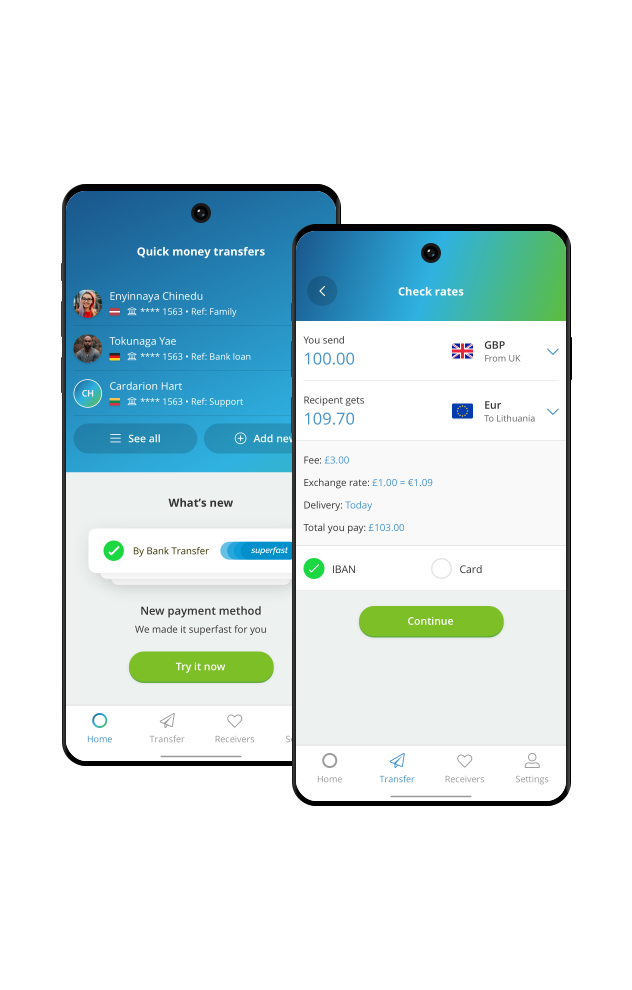




In our activity, we embrace technology and use them to offer fast, safe, and easy online money transfers. But when it comes to serving our clients and answering their concerns, we are a 100% human-faced business by speaking with them on the phone or online, and in their languages.
Almost twenty years ago, we promised to help you enjoy a better life in the UK, and it’s a promise that we will always honour.
The core engine powering Logos 3.0 was the . Developed as a modular ecosystem, Libronix allowed multiple publishers to issue digital books that could seamlessly "talk" to one another. The Internet Explorer Integration
The value proposition was staggering. Logos claimed the print value of the over 700 digital titles exceeded , yet the digital collection sold for a fraction of that at the time.
The digital age has revolutionized theological research, and for over two decades, has been at the forefront of this transformation. Among its most foundational and celebrated releases was the Logos Scholar Gold Libronix 3.0E suite. Released in the mid-2000s, this collection was designed for pastors, scholars, and serious students of the Bible who needed more than just a digital Bible—they needed an entire research library.
Modern operating systems like Windows 11 often block the legacy driver wrappers used by Libronix. Logos Scholar Gold Libronix 3.0E
Libronix allowed users to search the entire library—thousands of volumes—in seconds, pinpointing a Greek word usage, a specific theological phrase, or a historical cross-reference.
: It bundled hundreds of premium bibles, commentaries, dictionaries, and historical monographs.
To cover all aspects of the keyword, I need to gather more detailed information. I will open several of these results to extract details about the product's features, content, historical context, and technical aspects. search results have provided a substantial amount of information. I now have details about the product's features, content, historical context, and technical aspects from various sources, including reviews, community discussions, and archived pages. I will structure the article with an introduction, sections on the Libronix DLS system, the Scholar's Library Gold package, its content, technical details, installation, comparing its features to modern Logos versions, and a conclusion. I will cite the sources appropriately. The article will be comprehensive, citing the PDF review, the Galaxie article, the Ligonier review, the Equip the Called review, the community forum discussions, and other relevant sources. it comes to the landscape of digital biblical studies, few names command as much respect as Logos Bible Software. However, before the sleek, cloud-connected interfaces of Logos 10 or 11, there was a foundational era that set the stage for modern digital exegesis. For those who lived through it, the phrase triggers a wave of nostalgia—and perhaps a few installation headaches. This comprehensive article explores that legendary software package, dissecting its technical specifications, its monumental library of resources, and the broader historical context of the Libronix Digital Library System. The core engine powering Logos 3
: Resources purchased for the Libronix 3.0 system were designed to be compatible with later versions of Logos, ensuring long-term value for the digital library. Logos Community these older Libronix resources to the current Logos Scholar's Gold - A Review - Ligonier Ministries 18 Aug 2009 —
Seminal linguistic tools such as the Theological Dictionary of the New Testament (TDNT/Abridged Little TDNT), Brown-Driver-Briggs (BDB) Hebrew Lexicon, and Thayer's Greek Lexicon.
edition was the top-tier package of its day. It was remarkably expensive, retailing for approximately Logos claimed the print value of the over
: It officially required a 500MHz Pentium III processor and 192 MB of RAM, though 512 MB was strongly recommended for stable performance with a library of this size.
However, the licensing model introduced during the Libronix 3.0 era was surprisingly forward-thinking. Logos famously employed a model. If you had a legitimate license for Scholar’s Library Gold in 2006, that license is almost certainly waiting for you in your modern Logos 10 or 11 library .

© 2026 Real Palette Tribune

 Български
 Česky
Česky Latviešu
 Lietuvių
 Polski
 Română
 Slovensky
 Español
 Українська
 Magyar
 Italiano
 Austria
 Bulgaria
 Croatia
 Cyprus
 Czech Republic
 Denmark
 Estonia
 Finland
 France
 Germany
 Greece
 Hungary
 Ireland
 Italy
Italy Latvia
 Lithuania
 Luxembourg
 Malta
Malta Norway
 Poland
 Portugal
 Romania
 Slovakia
 Slovenia
 Spain
Spain Sweden
 Ukraine